The Partner Dependency That Quietly Stalls Most Debaters' Progress
November 10, 20269 min read1,924 words
Text: Outloud Debate Editors
Solo drills and AI feedback keep debaters improving between partner sessions.
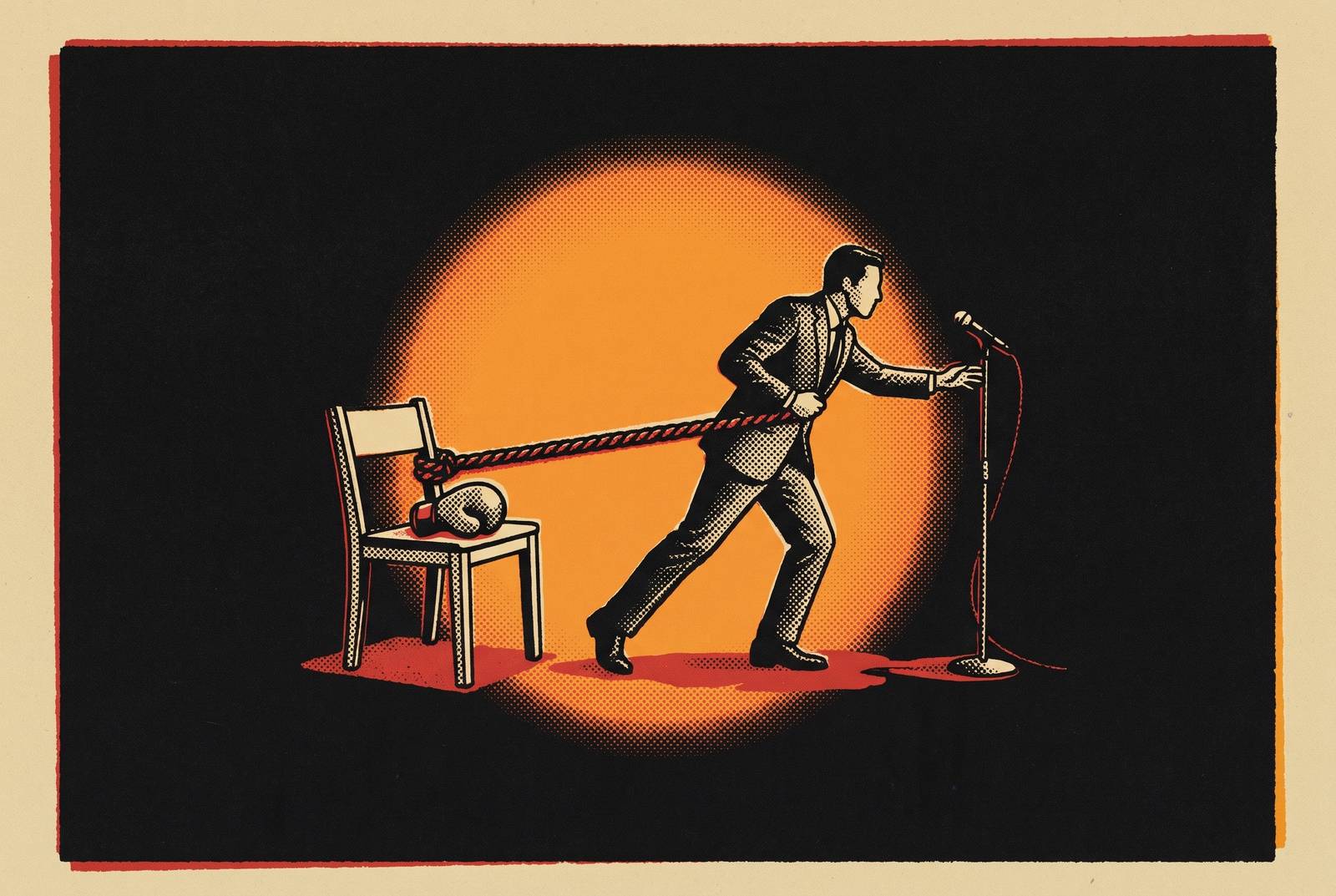
Daily debate practice without a partner needs a structure that produces spoken arguments, targeted repetitions, and usable feedback. A solo AI debate opponent can supply pushback between human sessions, while AI judging can return a scored verdict. Progress stalls when all three depend on someone else being free. The solution is to separate work that requires a live opponent from work a debater can complete and assess alone.
Why most debaters plateau despite genuine motivation
Debaters can want to get better but do little planned practice between meetings. The gap is not necessarily a failure of effort. When productive work requires another person to be free, a scheduling conflict removes the opportunity to train. WSDC Academy’s practice guide notes that most competitive school teams run one or two sessions a week, leaving five or six days of potential development untouched. That rhythm reflects institutional constraints.
The guide names three conditions for productive practice. A session must isolate one skill, produce output that can be judged, and return something useful, such as a score, a note, or a recording watched back. Most sessions fail at least one test. A full round isolates nothing on its own, while a solo exercise without assessable output offers no clear basis for correction. Partner dependency compounds this weakness because the meeting becomes a prerequisite even for work that does not need another person.
What partner work actually develops versus what debaters assume it develops
Live partners interrupt, push back emotionally, and bluff. A debater must also read their body language, pacing, and strategic shifts while deciding how to respond. These are distinct competitive skills.
Partners also provide accountability and strategic alignment. Potomac Debate Academy recommends short debriefs after every round and practice to discuss strategy and how the partners worked together. It also recommends that partners build a shared view of their strategy. Neither function depends on accumulating as many speeches as possible. Both require attention to how the partnership makes decisions and responds to problems.
But sessions with a partner often get taken up by work a debater can do alone. Debaters can brainstorm arguments beforehand, alone or with AI help, while a weakness visible in a round may need a drill aimed at it. Back-to-back rounds do not automatically repair the flaw. When preparation consumes the session, live resistance receives less attention. Doing that preparation elsewhere keeps partner time for the work that needs it.
The three solo drills that isolate the skills most practice rounds leave undeveloped
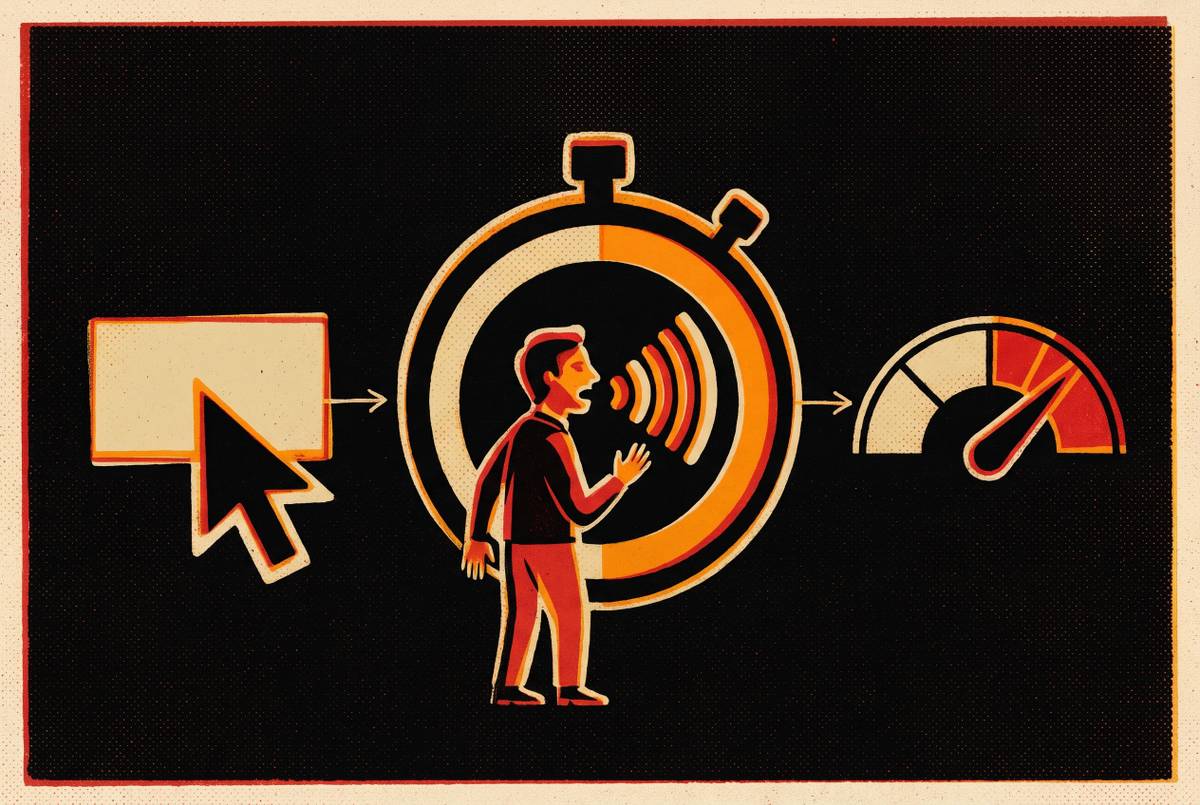
The practical response begins with three spoken drills. Each uses a motion and a timer to isolate a skill that a full round can expose without repairing. The guide points to a motion bank of more than 12,000 real tournament motions with a draw-one button. That supplies the input for all three exercises. Their value comes from assessing the completed output.
One-minute openings isolate framing, which the guide identifies as the highest-leverage skill in a round. Draw a motion, take five minutes of preparation, and deliver only the first minute of a first speech. Repeat the opening twice with different framing. The output is three deliveries of the same motion, allowing comparison without changing the underlying topic. Assess which framing holds together and which collapses under its own logic.
Rebuttal reps isolate the ability to answer an argument at the level of its warrant. Write the strongest argument possible for a side you disagree with, then stand and answer it using the four-step rebuttal structure referenced in the guide. The opposing case must be built before it is attacked. Measure the time from hearing the argument to delivering a fully structured response, with ninety seconds as the initial limit. Reduce that limit as improvement accumulates, while retaining the complete response structure.
Layer drills isolate the development of an argument. Take one claim and extend it aloud through tagline, mechanism, impact, and weighing in two minutes. The output is a spoken argument with each layer available for assessment. Note which layer repeatedly comes out thin. That recurring weakness becomes what the debater works on that week, so the exercise finds what needs work as well as rehearsing a familiar claim.
What the drill structure reveals about skill consolidation that marathon sessions miss
Speech skills consolidate both through work within sessions and in the intervals between them. Short sessions that work on specific skills across a week therefore lead to gains that last longer than the same time spent in one sitting. The interval is part of the design. It gives the next session a distinct role, returning to a skill after the previous attempt rather than extending an uninterrupted sequence of speeches.
The guide proposes solo drills on two weekdays, one partner session midweek, and one filmed speech or judged practice round on the weekend. The total is well under two hours. It presents that structure as more effective than a single three-hour Sunday marathon because skills consolidate between sessions. The contrast is between a rhythm that repeatedly targets and assesses skills and a block that concentrates all the work in one place.
That rhythm should remain responsive to diagnosis. When a tournament is four weeks out, practice can tilt toward full rounds. When the last round exposes a specific hole, the balance shifts back toward the drill that isolates it. The calendar becomes part of deliberate practice design, with the debater choosing when to develop a component skill and when to test it in a round.
How to use a partner session when one is available, so the time earns its value
To make scarce partner time count, use it to place solo-built skills under live pressure. The guide offers three structures for doing that. Each introduces resistance rather than repeating preparation that could already be complete. The session starts with the argument, structured rebuttal, or comparison the debater has already built.
In a POI gauntlet, one debater delivers a prepared argument for a few minutes while the partner offers points of information at regular intervals. The speaker takes two and declines the rest. The speaker must answer each point they take briefly while keeping the argument on track. The guide identifies this as the fastest available method for training composure under interruption. It puts the framing and argument development rehearsed alone into conditions where attention must be divided.
Turn-taking rebuttal extends the work of rebuttal reps. Alternate ninety-second speeches on one motion, moving from argument to rebuttal, rebuild, and rebuttal of the rebuild. The guide says that four exchanges take the clash deeper than most school rounds ever go. This structure requires each response to engage with what the previous speaker actually changed.
Blind weighing tests how well debaters compare arguments. Each partner writes the two best arguments for opposite sides, swaps papers, and delivers only the comparison of which argument wins and why. The guide identifies weighing as debate’s least-drilled skill and the one that decides close rounds. Here, the debater must use the weighing layer practised alone on someone else’s arguments.
How can a solo AI debate opponent support daily practice without a partner?
AI sparring can supply argumentative pushback when a human partner is unavailable. Its role is limited to the argument development and repetition involved in the broader experience of facing a person. Configuration is essential to that distinction. AI tends toward agreement because human-feedback training can reward agreeable responses, so an unconfigured exchange may validate a case and leave it untested.
For solo sparring, explicitly instruct the AI to hold its position, refuse concessions, and push back on every argument. The debater must still perform the argumentative work. When practising both sides of a topic, the useful criterion is sustained opposition to the side being rehearsed. An assistant that writes the reasoning removes the task the debater needs to practise.
AI judging fills a different gap in solitary practice. It can apply the same rubric across rounds and identify which criteria were met, referencing what was actually said. That is more useful than generic praise. Scoring rules published before the round make the verdict interpretable because the debater knows which standards governed it. For tool selection, sustained pushback, transparent criteria, and speech-specific feedback are therefore more relevant than fluent conversation alone.
These functions do not replace human coaching or community. Strategic decisions may require contextual knowledge of a particular opponent or format that an argument-level assessment does not provide. Accountability and the pressure of a real audience also require human structures. AI expands access to repetitions and judgment. It does not make live opposition unnecessary.
The unjudged round as the most common practice mistake and how to fix it
An unjudged round leaves each speaker free to score the exchange through existing biases. The loudest debater’s interpretation can become the result by default. Weeks of practice can then pass without correcting a persistent flaw, because no verdict identifies it as decisive. More rounds produce more performances, but not necessarily a clearer diagnosis. This is the final structural gap that drills and sparring alone cannot close.
The guide states that “the non-negotiable is that someone judges it and says why a side won”. Rounds show where a debater is weak, drills work on each weakness on its own, and judgment shows which one cost the round. Without that link, the natural response is often to schedule another round. With it, the debater has a reason to choose a particular drill.
Where a school cannot field judges, the guide identifies access to judgment as the single strongest reason to join a structured program. Coaching supplies a feedback function that self-study cannot fully replace. AI judging platforms can also return a scored verdict and written explanation within seconds of a final speech. The explanation is essential to the correction. A score without reasons does not identify which part of the performance needs work.
When no round or judge is available, a filmed speech watched back with a notepad provides the corrective function at the solo level. Recording separates delivery from assessment. The debater can hear the speech rather than remain occupied with producing it, making flaws visible that were missed during performance. The weekend choice is therefore one judged round or one filmed speech, never neither. Access to judgment, whether human, AI, or recorded self-review, separates practice that builds skill from practice that merely accumulates.
Building the practice structure around what you can control, not who is free Thursday
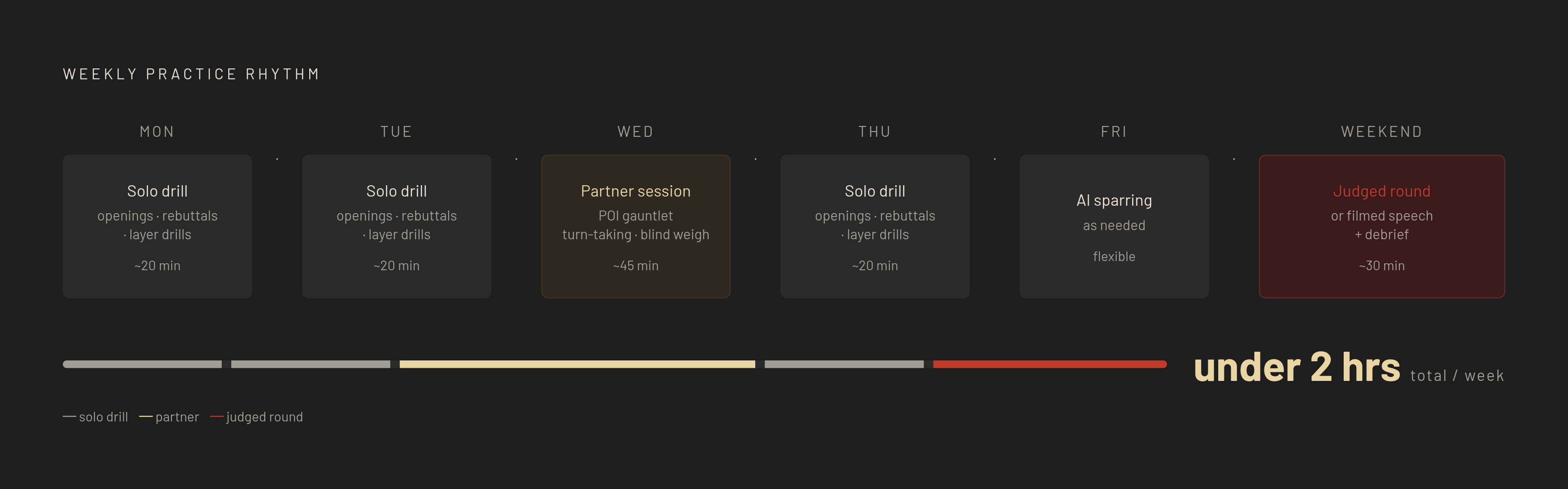
Fix two short solo sessions on weekdays and select among openings, rebuttal reps, and layer drills according to the last diagnosed weakness. Reserve a midweek partner session for the POI gauntlet, turn-taking rebuttal, and blind weighing, followed by a short, honest debrief. Use AI sparring for additional repetitions when needed. Keep the weekend slot for a judged round or, when judgment is unavailable, a filmed speech watched back.
As a tournament approaches, shift the weekend slot to a full judged round and increase partner sessions if schedules permit. If a specific weakness persists, direct solo sessions toward its drill until the score improves. If no partner is available for a stretch, use AI configured to push back as temporary opposition. Live human resistance returns as soon as it can.
The base week takes under two hours and works on every skill in the round. Its continuity no longer depends on every meeting happening. A cancellation changes the available form of resistance while leaving productive work possible. Today, pick a motion from a bank of real tournament motions, set a fifteen-minute timer, and run the one-minute openings drill.