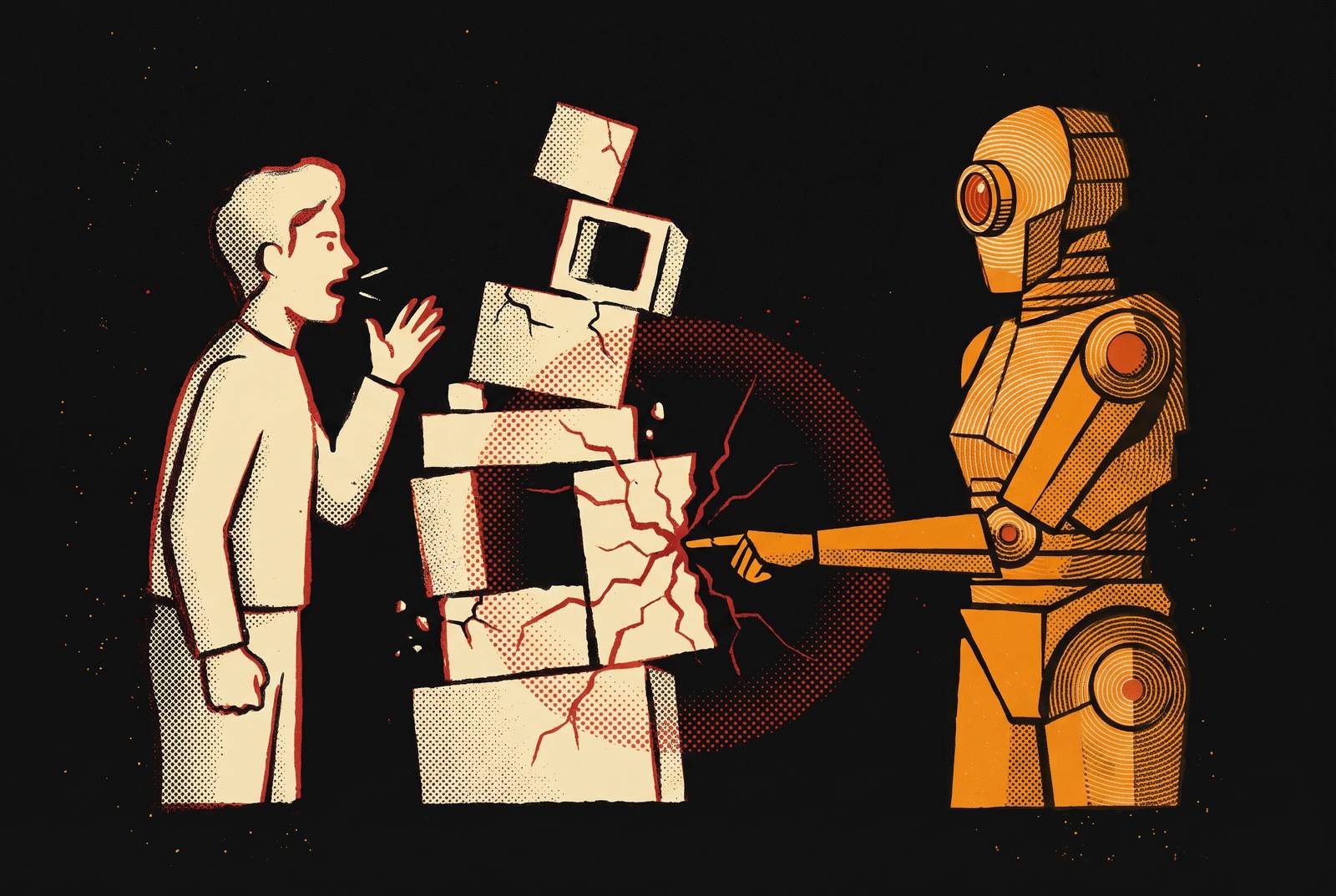
When the AI Opponent Refuses to Let a Weak Argument Stand Unchallenged
October 31, 20268 min read1,846 words
Text: Outloud Debate Editors
Purpose-built AI opponents expose weak reasoning by refusing to concede unsupported claims.
For solo AI debate practice without a partner, the useful opponent is one that holds its assigned side, attacks your specific reasoning, and produces a scored verdict citing what you said. Daily practice builds skill when the AI challenges an argument you wrote.
Why a debate opponent that never softens a rebuttal is structurally different from one that does
A sparring partner who nods through a weak warrant leaves the debater with a false signal. A coach who softens a rebuttal to avoid embarrassing a teammate can do the same. The argument survives, but not because it deserved to. Human partners have to look after their relationships as well as make their arguments, and doing one can get in the way of the other. An AI opponent has no relationship to protect, which removes one reason to let an unsupported claim pass.
The May 2025 Nature Human Behaviour study found that GPT-4 relied heavily on logical reasoning and factual knowledge, while human debaters used more expressions of support and storytelling. That distinction helps explain AI’s potential as a persistent examiner of weak reasoning. It does not make every chatbot a demanding opponent. A system must still be designed to press the user. Without that commitment, practice can reward an argument that an opponent in competition would punish, so its flaw stays hidden until more is at stake.
What “adversarial commitment” actually means in an AI opponent, and why most tools lack it
Adversarial commitment means the opponent must defend its assigned side for the whole round. Adversarial commitment requires deliberate design even in an intelligent model. Most tools sold as AI debate opponents are general chatbots with a prompt that tells them to debate. That arrangement does not, by itself, provide a stable round structure, a consistent position across speeches, or a judging rubric. Persistent pushback can become a route to agreement.
A purpose-built opponent closes that route by assigning the AI a side before the round begins and preventing it from abandoning that role. An opponent can sound firm as it slowly accepts the user’s premises, while a calm reply can still question every unsupported step. When the debater cites a study, the AI questions its methodology. When the debater makes a causal claim, it attacks the mechanism, and when the debater concedes a point, it presses the advantage.
How relentless rebuttal pressure forces the debater to find the actual flaw in their argument
A weak argument can fail at several different joints. Its evidence may not support the claim, its warrant may not connect the evidence to the conclusion, or its stated impact may exceed what the reasoning establishes. A concession hides those differences. If an opponent accepts the rebuttal and moves on, the debater cannot tell which step would survive closer examination. Relentless opposition makes those steps available for scrutiny because it refuses to treat a confident answer as a sufficient answer.
The pressure becomes useful when a counterargument targets the connection between claims. A debater who asserts a causal relationship must then defend the proposed mechanism. Each response has a narrower burden. If the evidence supports an association but the argument requires causation, more forceful delivery cannot supply the missing link. The training demand is to locate that gap and repair the reasoning.
Before arguing their own position, the debater asks the AI for the strongest possible opposing case. A straw man tests very little. It permits a clean rebuttal without requiring an answer to the other side’s strongest warrant. By contrast, a steelman makes the central disagreement harder to evade, because the debater must address a position that does not collapse under an obvious objection.
Losing a round without understanding the failed inference may produce frustration. An opponent that keeps attacking the same link gives the debater a clearer task: defend that link, narrow the claim, or change the argument. Refusal to concede is valuable only when the challenge remains responsive to the reasoning. Otherwise, persistence is just repetition, and the debater has no precise defect to work on.
What a scored, cited verdict adds that unscored sparring cannot provide
A scored verdict supplies a result, while a cited decision explains how the round produced it. Both functions belong in useful feedback. “You lost” cannot distinguish a weak opening warrant from a dropped rebuttal or a closing speech that failed to extend an impact. A written decision that quotes the relevant sentences and names the argumentative move gives the debater a repair target. It can also expose a contradiction between speeches that was difficult to notice while answering under pressure.
A judging panel adds another way to examine that result. ArguFight uses a panel of AI judge personas, each with a published paradigm, rather than leaving the outcome to a single judge’s weighting. That approach reduces reliance on one perspective. It does not eliminate the possibility of error, particularly when an unconventional but strong argument fits a template poorly or a model reflects biases from its training data.
When the criteria are published and decisions refer to what was said, people can check whether a judgment follows its stated rules. A score without reasons gives them no way to check. A cited decision can be challenged at the point where its interpretation diverges from the argument, so even a disputed verdict can identify something concrete to review.
The dependency trap — when AI practice replaces thinking instead of training it
AI use can be assessed by whether it creates cognitive demand or removes it. An opponent that attacks a debater’s reasoning requires the debater to do the repair. A case-writer that supplies the reasoning performs the task the debater needs to learn. Those uses can look similar when judged only by the quality of the finished speech. They differ when the assistance disappears.
Bastani et al. (2025, PNAS) found that students given hints and guided thinking performed similarly to the control group on unassisted tests, while students given direct answers showed a significant lasting decline in performance. The study concerned assistance rather than debate practice, but its distinction clarifies how assistance can affect independent performance. Better supported performance is not necessarily better independent performance.
For a debater, the practical signal is straightforward. If the case cannot be defended in the debater’s own words without AI present, the tool has supplied something the debater has not yet mastered.
How can you practice debate every day without a partner and avoid dependency?
Give each round one adversarial target. That target can be rebuttal speed, warrant depth, or impact extension. The debater then uses the feedback to assess that dimension rather than treating the overall verdict as the only measure. The distinction keeps the session focused on a skill. A win can coexist with an unsupported warrant, just as a loss can leave a stronger rebuttal worth retaining.
To train both sides alone, the recommended drill is to run the same topic twice with opposite positions. The debater argues for the proposition, then against it. This reversal changes the burden of defense. The AI’s responses can expose weaknesses in the first round’s arguments when it presses the same points the debater previously made. The debater has to do more than gather arguments for both sides, because each position has to hold up against a reply.
In this sequence, steelmanning comes before the debater builds the case, and the cited verdict comes after the round. The debater still builds and defends the case. For progression beyond solo sessions, the recommended sequence is AI for volume and live 1v1 for pressure. AI practice develops content skills such as structure, rebuttal speed, and warrant analysis, but it does not reproduce a live room’s social pressure or the unpredictability of a human opponent who knows the debater’s usual lines.
How purpose-built AI opponents serve competitive debaters, and where the institutional rules sit
Competitive debaters need practice that respects the structure of their event. A capable conversational opponent is not enough if it cannot provide the relevant speeches, questioning, or judging framework. The named tools serve different practice needs, and their listed features do not establish a single best platform for every solo debater.
DebateOwl covers School 4-6-6-3, Lincoln-Douglas, and Public Forum, with timed practice rounds called Sparring and separate Crossfire drills. PracticDebate.ai (DebatePro) supports Lincoln-Douglas, Public Forum, Policy, and Parliamentary, with cross-examination and AI judging trained on NSDA standards. Their format coverage is not identical. A debater seeking a particular event structure has a more concrete basis for comparison than a general claim that a tool can argue.
PublicForum AI is for Public Forum only, with cases, flows, and practice rounds. Its free tier has 3 practice rounds/month, while its paid tier has no round limit and adds evidence with sources. Debate Ladder is built for voice practice with an Elo rating. Debaters take PRO or CON and speak out loud against an AI opponent in an opening, a rebuttal, and a closing. It scores logic, responsiveness, clarity, delivery, and persuasiveness, making spoken performance an explicit part of the feedback.
The institutional distinction is between preparation and live assistance. AI practice is permitted and encouraged, while AI assistance during a live round is not. A purpose-built opponent serves the preparation side of that boundary by providing opposition before competition. A chatbot that writes a case during live prep gives help during the event. The educational rationale follows the same division, because rehearsing independent reasoning differs from receiving reasoning to read aloud.
Why the same adversarial mechanism that sharpens debaters also changes minds
Anyone defending a view they truly hold has to explain the reasoning behind it when an opponent asks for evidence and replies to the claims they made. Passive reading does not impose that demand. A reader can pass over a difficult objection without stating a warrant or defending the inference.
The 2024 Science study found that AI dialogues reduced confidence in conspiracy beliefs by roughly a fifth, with the effect persisting for at least two months. Participants offered their evidence and reasoning, and the AI responded to their specific claims. That exchange shares debate practice’s central structure. A position must be stated, supported, and defended against a reply that does not simply accept the conclusion. The finding concerns belief change, but it illustrates why targeted counterargument differs from a generic presentation of contrary information.
The Nature Human Behaviour study found that GPT-4, when given personal information about opponents, was more persuasive than human debaters a majority of the time. The researchers noted the risk of large-scale disinformation. The same ability to tailor a challenge that makes practice demanding can therefore be used for purposes the participant does not understand or endorse.
The governing principle is transparency about what the system is doing and why. For judging, that means published rules, citable decisions, and appealable verdicts. For an AI opponent, it means being clear about its role and what it is trying to do, including any aim to persuade. Adversarial pressure is a training instrument only when the participant can inspect the terms under which it operates.