What a Complete Beginner Actually Does in an AI Debate App the First Time They Open It
November 17, 20268 min read1,842 words
Text: Outloud Debate Editors
A first session runs from topic pick to scored verdict.
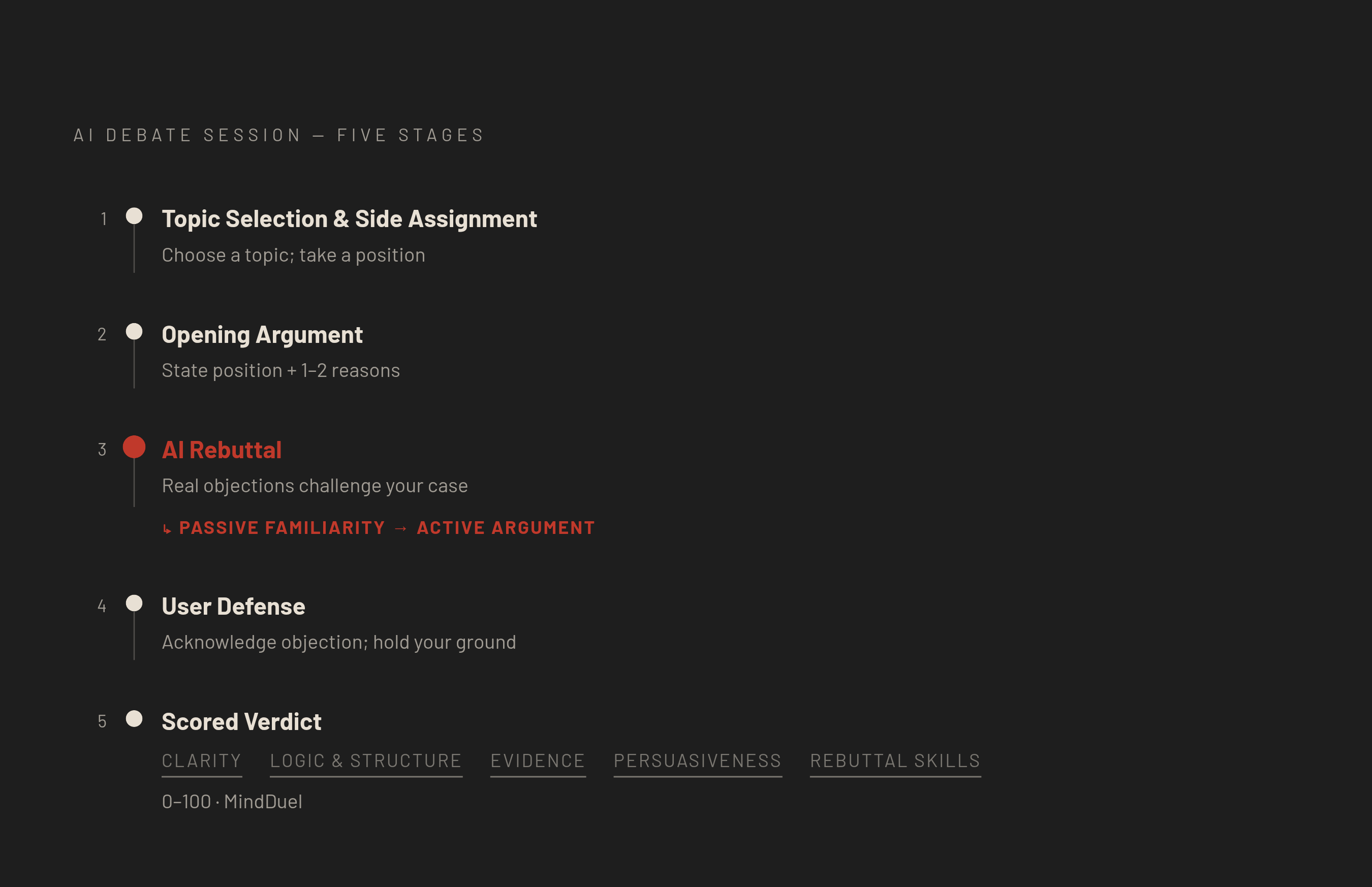
A structured AI debate practice app gives people who have never competed an opponent, timed turns, and a verdict with reasons, so they can practice without joining a club. A beginner’s first session moves from topic selection and side assignment through an opening argument, an AI rebuttal, and feedback. Understanding that sequence makes the first attempt useful rather than confusing, because each stage has a specific job.
Why the first session in an AI debate app feels confusing before it feels useful
The first obstacle is usually an expectation mismatch. The term “AI debate app” covers products that ask very different things of their users. Benchmark arenas rank AI models by vote, comparison tools show responses side by side, and multi-model chat apps offer conversations with different models. AI-versus-AI platforms let models rebut each other, while practice apps put a person into the argument. Someone who expects to speak can thus open a debate product that has no speaking role for them.
This walkthrough concerns the practice app. Here, the user speaks or types a case, an AI opponent responds in structured rounds, and a scored verdict follows. Having to take part can make the app feel like hard work at first, before it feels helpful. The app needs an argument to challenge before it can provide feedback about how to improve it.
Picking a topic: what makes a good first-round motion and why it matters more than it seems
The topic sets how much work the beginner must do before speaking. When the user knows the subject, they can focus on putting a position into words within the time available. Familiarity alone, however, does not make a motion manageable. A broad proposition such as “capitalism is good” leaves too much to define and defend within a timed turn. A focused proposition with a clear yes-or-no line gives the opening a more precise target.
The side is a separate decision from the topic. Many apps let users choose which side to defend, while some choose it for them. An assignment that conflicts with a personal belief is deliberate. It creates the need to understand and inhabit an opposing view. For a first round, the practical choice is therefore a narrow topic the user already understands and would actually argue about, even if the assigned side is unfamiliar.
What the structured format looks like before the first word is spoken
Once the topic and side are settled, the round supplies the container for the argument. Unlike an open chat window, a structured debate has an opening, a rebuttal, and a closing, with each side speaking in a defined order. Those turns have different purposes. The opening establishes the case, the rebuttal answers the opponent, and the closing brings the argument to its conclusion. Knowing which turn comes next lets the user keep arguing without also having to work out what a surprise prompt asks them to do.
MindDuel offers debates between the user and the AI, adjustable thinking and speaking time, and difficulty levels of Beginner, Intermediate, and Expert. Practice Debate sets up rounds like those in real tournaments, with voice interaction, cross-examination, and AI arguments in real time. The practical preparation is to read the round structure screen fully, including the number of turns, the length of each turn, and when the AI responds. This allows the first round to be spent making a case.
Delivering the opening argument: what to say, how long to speak, and what the AI is listening for
The opening is where uncertainty becomes most visible. Beginners may freeze because they cannot find a starting point, or ramble because they cannot identify a stopping point. Both problems come from treating an opening as an undefined performance. A functional opening has a simpler structure. It states a clear position, gives one or two reasons for that position, and explains why those reasons are consequential.
For the first attempt, the practical method is to use the thinking time to write one sentence containing the core claim. Speak that sentence first. The reasons can then support a position the opponent already understands, instead of requiring the opponent to infer the claim from a long introduction. The allotted speaking time sets the outer limit, but it does not require a more elaborate case. Adding more than the core argument needs takes the case off track without making it stronger.
Voice input makes that discipline especially useful. Practice Debate is voice-first, with real-time interaction, so the argument must work when spoken, without the chance to revise a paragraph before sending it. Silence can sound like hesitation even when the user is thinking. MindDuel uses voice-to-text, transcribing the spoken argument so the opponent can read and respond to it. At this stage, clarity of position and logical structure count more than eloquence, so a plain claim with a discernible reason is stronger than confident delivery without a case. An imperfect opening remains recoverable because the round continues.
How the AI opponent responds and what to do when it makes a point you weren't expecting
The AI’s first rebuttal changes the task from presenting a position to defending it. Practice Debate describes its opponent as constructing arguments, cross-examining, and responding in real time based on what the user said. The response is not merely a prepared counterargument attached to the topic. It engages with the case just presented. An objection the beginner did not expect is thus part of the practice, and gives them no reason to think they chose the wrong app.
The common mistake is to abandon the original case and chase the new point. A more effective response briefly acknowledges the objection, then explains why the original argument still holds even if that objection is granted. This preserves the thread of the debate. It also separates conceding a particular point from conceding the whole position, which a beginner may initially treat as the same thing. Completing that move once is a meaningful first gain in rebuttal skill.
The difficulty is the source of the practice value. A balanced summary can explain both sides without testing whether an argument holds up against them. An adversarial opponent instead looks for contradictions, unsupported claims, and logical gaps in what the user actually said. Its response therefore exposes weaknesses that a monologue can leave untouched. A weak first rebuttal is not a reason to leave the round, because the struggle to answer identifies what the next opening needs to address.
How can you get feedback on your arguments without debate experience and read the scored verdict?
The scored verdict tells beginners how they did, even if they have never learned how debate judging works. Its most useful component is the reasoning. A number reports a result, while an explanation identifies what produced it and what could change. Reading only the score turns a practice tool into a grade.
MindDuel gives a total score from zero to one hundred across five criteria, including Clarity, Logic and Structure, Evidence and Examples, Persuasiveness, and Rebuttal Skills. It also provides a concise explanation after each debate. Practice Debate provides detailed evaluations from an AI judge trained on NSDA standards. These cover speech delivery, filler words and pacing, what the user did well, where they could do better, and advice on how they can improve. The two descriptions show why feedback needs to be read at the criterion level rather than treated as a single judgment of debating ability.
The practical reading order is written reasoning first, followed by the lowest-scoring criterion. That identifies one target for the next round. When an app publishes its criteria before the debate, the user can prepare for a known rubric. An explanation tied to what was actually said is also checkable, while a consistent rubric makes progress trackable across rounds. AI judges may undervalue unconventional arguments that do not fit a standard template, so the reasoning is best treated as a coaching note.
Why the second round feels different from the first, and what that shift tells you
The second round begins with information the first could not provide. The beginner has heard an objection to the opening and received feedback on how the argument was delivered and defended. The task is now more specific than “argue better.” Even with the same topic, the next opening can deal with a weakness the user had not seen before. This is why the change between the first and second rounds can be especially pronounced.
Watching another person respond to pressure does not create the same loop of making a claim, receiving a challenge, and revising the next attempt. The practical habit is a single round on a topic the user cares about, repeated consistently. The timer and the verdict give each attempt a defined constraint and a concrete result.
MindDuel helps users move forward with its difficulty levels, debate history that it saves automatically, and global leaderboard. More importantly, users can keep practicing and get feedback each time. Quality debate preparation has historically required a coach, a team, or a well-funded program. A practice app that delivers a scored, reasoned verdict immediately after a spoken round changes who can obtain those repetitions.
What to do after the first session ends: the three decisions that determine whether the habit sticks
The first decision is the next topic. Choosing it before closing the app removes a choice that would otherwise delay the next session. The first session therefore ends with preparation for another attempt.
The second decision is the target drawn from the verdict. The lowest-scoring criterion becomes a short practice note that frames the next round as an attempt to improve one thing. This turns feedback into a plan. A weak result in rebuttal, for example, gives the next response to the opponent a specific purpose rather than leaving the user to seek a higher total by unspecified means. The target connects one session to the next without requiring a complete redesign of the argument.
The third decision is the next practice format. The user can try another solo AI round at higher difficulty, a live round against a person, or a round on the side they do not personally agree with. Each changes a different part of the challenge. Higher difficulty changes the level of opposition, a live opponent changes the interaction, and switching sides tests the ability to inhabit another view. Platforms combining AI sparring, live human matchmaking, and a leaderboard make these routes available within a broader progression.
Practice Debate supports AI opponents, cross-examination, judging, performance tracking and analytics, and full speech transcripts, allowing practice to develop into competitive preparation. The underlying model is closer to chess training than classroom discussion. It needs an opponent or credible simulation, a score, and a reason to return. A first session ending with a verdict, a practice note, and a queued topic demonstrates how far the access barrier has fallen. The beginner does not need a team, a coach, or a tournament date on the calendar, but a topic, a side, and a willingness to speak.